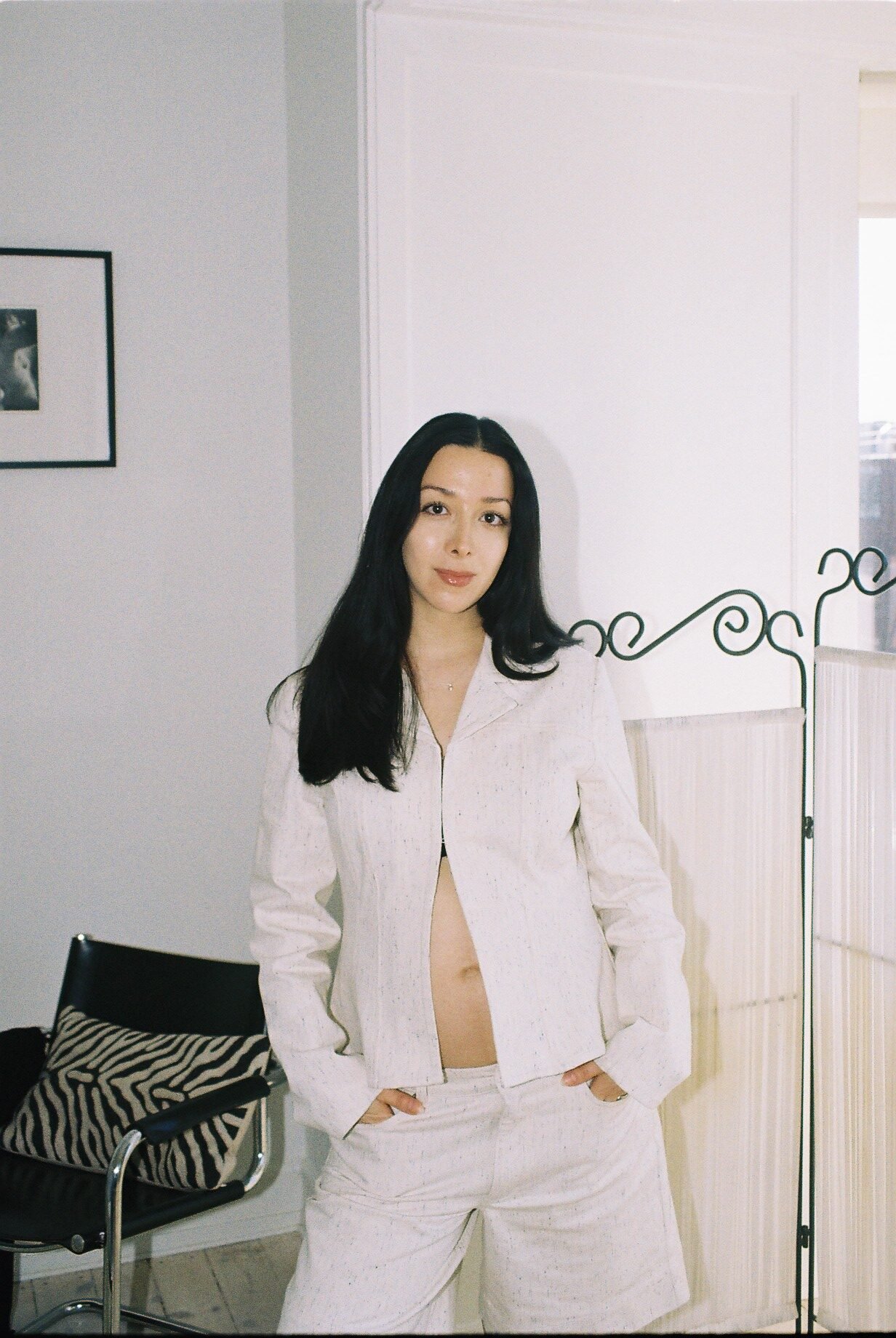
Interview with
Vanessa Salgado
Architect & Creative Director
Interview

Vanessa Salgado

Architect & Creative Director

From early on, Vanessa knew she wouldn’t stay in Mexico. After finishing her studies in architecture, she sought out new experiences abroad – first Barcelona, later Copenhagen – as a way to step outside tradition and redefine her path. But the journey was not without struggles: distance from family, cultural contrasts, and the heaviness and loneliness of starting over. Yet it also gave her the chance to build something new – from a wedding that symbolised connection over formal traditions, to the founding of her design studio ‘Es Ness’, created with her twin sister as a practice devoted to depth, curiosity and deeper bonds. For Vanessa, life and design are inseparable – both about staying curious, breaking patterns, and building something meaningful.

Editor's note: There is a clear sense of taste and consistency in how Vanessa presents herself and the spaces around her, often leaning into black and white without ever feeling rigid. It is simply her way of seeing. What defines her more is how she shows up for others. She is attentive, generous, and deeply supportive, the kind of person people return to and rely on. What initially reads as a story about a wedding quickly reveals something else. Not a celebration for the sake of it, but a reflection on connection, identity, and the people we are shaped by, and choose to gather.

Q no. 01.
What led you to move from Mexico to Denmark, and how did your decision shape your life? 

Living in Denmark is something that I never envisioned. It’s such a big contrast from where I’m from. I knew I didn’t want to stay in Mexico, but where I would go instead was unknown to me. I already knew how my life would turn out if I stayed in Mexico. It’s a very traditional environment, and I just didn’t want that life. I studied architecture in Mexico, and after I graduated, I knew I needed to take a break from my laptop. It's so funny how you end up manifesting things without even trying because one day, while running errands, I suddenly couldn’t find my laptop. I assumed it had been stolen, because there was no sign of it. It contained my entire portfolio – everything I needed to land my first full-time job. I was devastated, but in a way, I got exactly what I had wished for – a break from my laptop.

Eventually, without a portfolio, I managed to get an internship at an architecture studio. I worked there for over a year and managed to become Junior Creative Director. But then the start of Covid came and once again, life forced me into a pause. I spent long periods in solitude and started meditating almost daily, sometimes for three hours at a time. At one point my body and mind began resisting the practice, and when I reconnected with it, a message came through clearly: “Quit”. I realised I didn’t want to work in a studio with that pace and pressure, overworking without a meaning. I wanted to dig deeper into my professional interests and finally leave my hometown – which turned out to be in Barcelona.

Barcelona has this energy, where everyone is happy and energetic, and it feels like a long vacation. When you are on vacation you feel this excitement – a more childish curiosity, which was exactly what I was craving. That curiosity led me to really interesting people and places, because I started to connect with people on a new level. I got out of my comfort zone, going to different environments, events, and meeting new people. I became a person who really aligned with the person I wanted to become. I wasn’t even meditating because I was living the life I wanted to manifest back when I wasn't sure about my routinary life in Mexico. So instead of falling into a routine, I was doing the exact opposite.

Because I was going out of my comfort zone, I took more chances and opportunities, and that led me to meeting my now Danish husband. I started dating him as an experiment without expectations. Eventually, I understood that meeting him was fate, and he introduced me to Copenhagen.

The first time I visited Copen­hagen, the city triggered something deep and positive in me. I felt immediately and strongly inspired by being there, and I felt like this was a place that could open my creative mind. It was just a feeling, and on my own initiative, we moved to Copenhagen together to start a new life. 

During the ceremony, guests were invited to take part by writing down wishes and attaching them to a long piece of fabric laid out in a circle on the ground. The couple stood within this ring as they exchanged vows, surrounded by the wishes of their loved ones.

Q no. 02.
How has it been starting a new life in Copenhagen? Is there anything that has been difficult, now that the culture is so different from what you are used to? 

Creating a life in Copenhagen has been the hardest choice I have ever made. Migrating and moving away from my country was already tough, but at least in Barcelona I spoke the language and the culture wasn’t shockingly different.

With time, I’ve come to feel deeply happy about my decision to move – but in the beginning it was really hard. For a second time, everything I had built before vanished. It was just me, and the unknown.

I was faced with such a different culture that it made me question a lot of things, because nothing felt relatable to me; it was scary, but of course still exciting. But I started doubting myself a lot. I felt invisible as if I had nothing, because everything I had built before simply didn’t exist here.

My twin sister and I have always been a team, and not having her here was also a really strange feeling. She’s like this life partner, my soulmate from birth. Yes, I had my husband, Mathias, by my side, and I loved that, but I needed to find my own place and purpose, and navigate in this new environment – and that was a bit lonely. He already has his whole life established here, so it was about finding my place here. It made me grow a lot, because my ego dropped down, and I had to really understand who I was without anything that I previously had. I had to see myself as an individual for the first time, and rebuild my self-worth.

The outcome was that I became proactive and started building the things I was missing. And now, two years later, I feel I’m in a place where I like this life more than my previous ones. But that’s only recent – before that, I preferred my previous life.

Q no. 03.
What does the wedding mean to you? Was it important for you to have a big wedding?

I’m in a place where I’m in love with my life here – with this energy, feeling complete. I look back on my previous lives and I’m so happy they happened, but this chapter is definitely the best one so far. Mathias and I got legally married two years ago, just for practical reasons. But there was no rush for a wedding, and at that point I was still rebuilding myself, so the timing wasn’t right. I didn’t even want to celebrate, I didn’t feel like it, and I never dreamed of having a big wedding anyway. Of course, it’s nice to have a wedding, but it was never really a dream of mine. Still, I knew that I might never get the chance to see everyone I care about at once, so for me, it was important to have a wedding and invite everyone Mathias and I care about.

Even though I don’t really dwell on the past, when Mathias and I first started dating, I felt like I missed his past self. There are lots of things I couldn’t picture about his life before me, his childhood, all these things, it was hard when we don’t come from the same culture. But by moving to Denmark I realised that the people close to him know all these past versions of him that I missed out on. And I found out that by getting to know his family and the people around him, I started to understand him much better and connect to his past selves.

We are all shaped by the people around us. And I wanted to honour his and my people more than just us – in the shape of a wedding. We are so loved, and even though we have moved and lived in different places, there are still people all over the world who have shaped us into how we show up in our relationships.

Love is about connection. Spreading love by finding really interesting and inspiring people and then bringing them together. We have all these amazing people, so I wanted to host something for them and for us. I rarely see my loved ones, so for me to see them all together at once, connecting and bonding across 23 nationalities, is truly heartwarming.

And as I mentioned before, I never dreamed of a big wedding – but I’m a designer. I’ve done weddings, I love events, I love hosting. So doing my own wedding and caring about the aesthetics came simply naturally to me.

In my studio, every project begins with a concept. For my wedding, I created the concept of ‘Intertwined Bonds’. We wanted to tell everyone: “We are bonded to you, and to each other”. That was the whole reason why this wedding came to be.

“With time, I’ve come to feel deeply happy about my decision to move – but in the beginning it was really hard. For a second time, everything I had built before vanished. It was just me, and the unknown.”

Q no. 04.
Why did you choose Madrid as the place to celebrate your wedding?

We wanted to find a middle ground for our wedding location. Mexicans would be flying transatlantic, and flight connections needed to be as smooth as possible. My husband and I met in Barcelona, so Spain became our first home as a couple. My sister lives in Madrid, and each time we visit, we find ourselves enchanted by the city. Choosing it also meant it wasn’t going to be a Mexican wedding in Mexico or a Danish wedding in Denmark. We wanted something fused. Something that belonged to us, rather than to our nationalities.

That day was about our bond as a couple, but also about celebrating the bonds we share with everyone else. We didn’t take it for granted that people travelled such long distances and put in the effort to be there – only three of our guests actually lived in Madrid. So even though Madrid is a beautiful destination, we felt a responsibility to make the wedding worth the journey. Every detail was planned with that in mind: the atmosphere, the ceremony, and the way we included our guests.

During the ceremony, we invited everyone to take part by writing down wishes and attaching them to a long piece of fabric laid out in a circle on the ground around us. We stood inside this ring as we exchanged vows, surrounded by the wishes of our loved ones. For me, it was a way to make the ceremony feel less like a performance and more like a shared moment – where every single person present became part of what we were building.

Later, in my toast, I thanked everyone – not only for coming, but for being part of our journey. I wanted the evening to feel like an invitation: a chance to create new bonds, both with us and with each other. That was really the essence of the day – honouring connection, and giving people the space to meet across cultures and histories.

“We didn’t want to prefer Denmark over Mexico, or the other way around. So we looked for a blank space where we could do whatever we wanted. For international weddings it’s common to use flags of each country, but instead we chose small, subtle hints of Denmark and Mexico. For our candle holders we used liquorice spaghetti strands for the Danes, and for the Mexicans, black chillies.”

Q no. 05.
How would you describe the atmosphere you wanted to create for your wedding day?

I knew that all the details and meanings behind ‘Intertwined Bonds’ were coming from a deep place. But one of my fears at the wedding was: what if no one noticed the hints or understood them? For example, there were many knots and rope-like elements. Instead of an abundance of flowers, I had a florist create one central piece – a knot made of plants. My bouquet was circular, symbolising union. There were many subtle details, and I worried they might go unnoticed.

We also wrote a handwritten letter to each guest, and on the envelope we attached a small piece of thread tied in a loose knot, with the words: ‘Threads intertwined in the form of bonds’. The idea was that we are all individual threads, but here we would create new knots, new bonds, and new connections.

While we paid close attention to the wedding theme in the decorations, we didn’t want anything to feel over-the-top. A big, fancy cake and the traditional cutting ceremony felt a bit too performative for us. Instead, we went for a more unconventional option – doughnuts, which people could grab whenever they wanted.

Since we’re not religious, a close friend led the ceremony. She guided us through a ritual where we extended our arms, holding each other’s hands, and wrapped them with a piece of fabric. When we pulled our hands apart, the fabric tied itself into a knot. That’s where the saying ‘tie the knot’ comes from, and it became such a meaningful detail. For me, that moment was incredibly expressive and I think that’s where the concept clicked for people.

But we didn’t want the guests to become an audience. This was never only about us as a couple – it was about everyone. If it weren’t for the people around us, we wouldn’t be here together. As I mentioned earlier, we are shaped by our experiences and relationships with our loved ones. That’s why my vows weren’t only about my husband, but also a toast to everyone present. I wanted to express my deep gratitude – not only for my relationship with him, but also for the interconnectedness we share with all those around us.

Later, when the party truly started, it felt like one big family. My friends from Spain and Mexico were carrying my husband’s Danish dad, and I noticed my Mexican grandmother deep in conversation with a friend from Barcelona. In that moment, it truly felt like we were all connected. People were hugging, chatting, and dancing together – no one stayed in their familiar group.

It also helped that we hadn’t chosen a huge, showy venue. Instead, we found a beautiful villa with low ceilings. As an architect, I immediately thought “this will be perfect”. It made the atmosphere warm and intimate, more like a real home. Even the dance floor wasn’t a massive open space – with the low ceilings, it felt like a house party full of energy, closeness, and that sense of ‘hygge’.

While close attention was given to the wedding theme in the decorations, nothing was intended to feel excessive. A large, elaborate cake and the traditional cutting ceremony were set aside in favour of a more understated approach – doughnuts, available for guests to take at their own pace.

“We also wrote a handwritten letter to each guest, and on the envelope we attached a small piece of thread tied in a loose knot, with the words: ‘Threads intertwined in the form of bonds’. The idea was that we are all individual threads, but here we would create new knots, new bonds, and new connections.”

Q no. 06.
How did your design studio come to life?

I’ve always loved sharing ideas and helping other creatives. Over time, I realised I was actually quite good at giving insights on people’s creative projects. Back when my sister and I were still living in Mexico in our early twenties, we had countless conversations about collaborating creatively. From early on, we were already a creative team in that sense – people would often come to us for input. Eventually, we each followed our own paths: me in architecture, my sister in advertising. But after finishing our master’s degrees, we started asking ourselves, “What’s next?” We realised we had enough in common to take our previous professional experiences and turn them into our own studio.

From early on, we were already a creative team in that sense – people would often come to us for input. Eventually, we each followed our own paths: me in architecture, my sister in advertising. But after finishing our master’s degrees, we started asking ourselves, “What’s next?” We realised we had enough in common to take our previous professional experiences and turn them into our own studio.

When you start a project like a studio or a brand, you might have a clear ambition, but it often develops into something you didn’t expect. A brand – or any creation – starts with an intention, but once it’s out in the world, it takes on a life of its own.

The first thing we did was create the foundation for what we wanted the studio to become. We knew that what we shared was a passion for creation, and our values and vision aligned perfectly. Even though we studied different fields, our skills complemented each other in unexpected ways.

We also really love second-hand shopping and flea markets, so it’s very important for us to always think sustainably when it comes to decorations. Buying new would feel like a waste, and second-hand finds have so much personality; each piece has a previous life and comes with its own story.

What we wanted with our studio was to awaken consciousness in people. That’s why our studio is called ‘Es Ness’. It’s ‘sense’ spelled backwards – a hidden message expressing our philosophy: to explore deeper layers and create work with intention. We added an extra ‘S’ for personality, as our last name has a double S. In that way, we’re already practising what we want to do: presenting work with a subtle message.

We did this wedding once where the bride’s style is always unexpected. The way she dresses is really cool – she mixes and matches in ways you would never think of. So for example, in the ceremony, we rented three completely different types of chairs – and we just mixed them randomly. Even the rental place was like, “How many guests are there? Why are you choosing these chairs?”. But that’s how we work – a way that reflects the client’s personality while going beyond what you’d usually expect.

We know our core, our philosophy, and what we want to achieve. We aim to move away from trends and convenience, instead exploring deeper layers, creating work with intention and originality, and expressing the personality of the creators we collaborate with – always with our sense of style.

What we wanted with our studio was to awaken consciousness in people. That’s why our studio is called ‘Es Ness’. It’s ‘Sense’ spelled backwards – a hidden message expressing our philosophy: to explore deeper layers and create work with intention. We added an extra ‘S’ for personality, as our last name has a double S. In that way, we’re already practising what we want to do: presenting work with a subtle message."

Q no. 07.
Where do you draw inspiration from? What state of mind makes you come up with ideas the most?

For me, the best source of inspiration comes from breaking patterns – not taking the easiest or most typical path, but doing the unexpected and going against the norm.

We handle projects in similar ways, but the process is never exactly the same. We don’t follow rigid steps. First, we do creative research and let it sink in. After that, how we proceed depends on the client.

For example, we worked with an artist whose brand we were creating. Instead of asking for typical materials, we asked for intimate photos of her notebooks, and notes about her thoughts – these became the source of the project. Our approach was simple: “You’re an artist; we need to dig into your mind”. For me, breaking the usual routine is key to finding inspiration, while also leaving space to explore each client’s mind. Every unique mind holds a new perspective.

Inspiration for me also comes from calm and solitude. Learning to spend quality time with yourself is essential. Resting is good, but if you only spend your alone-time scrolling on your phone or zoning out, you don’t train the ‘muscles’ in your brain where the inspiration gets triggered and the creation begins. When I’m alone and fully present, I connect with myself in a way that allows me to understand and explore new ideas – it’s rooted in curiosity. 

I get inspired by many things – Copenhagen, social media, conversations – but those are external inputs. They’re stored in your subconscious, and while valuable, they’re still predictable. They can lead you down paths that are already traced, so your work may resemble what already exists. There’s nothing wrong with that – sometimes clients specifically request it – but if I want to train my creative muscle, it happens in moments of solitude.

To put it into perspective: my sister and I look alike and even sound alike, but since we were little, I’ve understood that the thing that truly differentiates us is our minds. Inside everyone’s head is a world of its own. I believe the best source of inspiration is within yourself. You won’t find it unless you allow yourself to be fully present, perhaps trying new activities, but alone. Being alone on good terms with yourself and doing something productive is, for me, the most powerful way to spark creativity.

Portraits by Mariia Dromova
Reference photos by Flo.weds
All rights reserved.