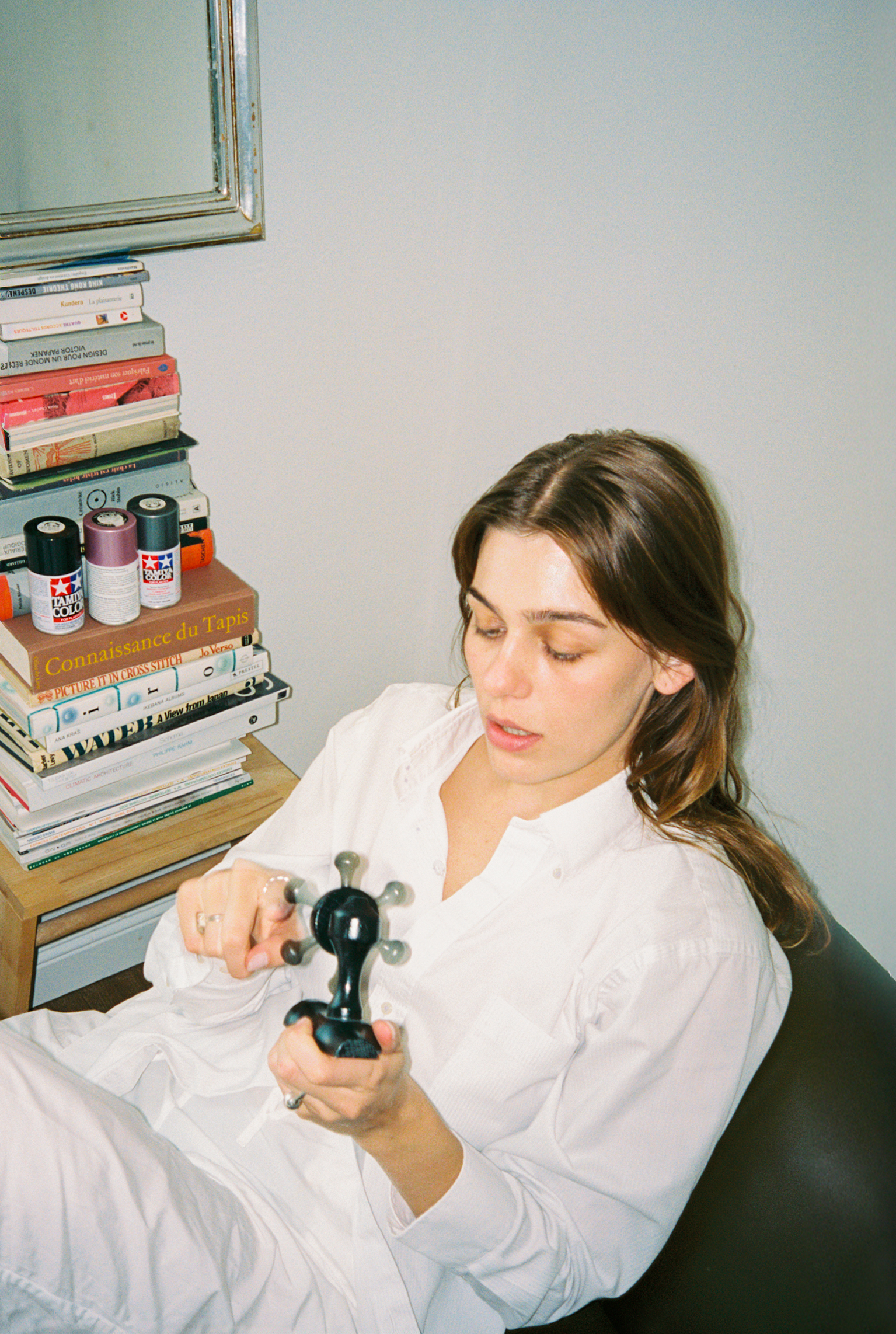
Cindy Sacher manages to see and capture beauty in small things that most people wouldn’t think twice about. There’s a presence in the still photos she takes that gives some a sense of peace. The photos and the objects are so simple, and yet we take their beauty for granted. Designing with purpose, not necessarily for beauty – Cindy gives unintentional design a new space. The focus isn’t on the surroundings but on the object itself – and how that single moment can stand on its own, sometimes serving no purpose other than simply being. It’s important to just be; to be still and to take the time to notice the little things that normally would go undiscovered, unnoticed – even when they’re standing in plain sight.
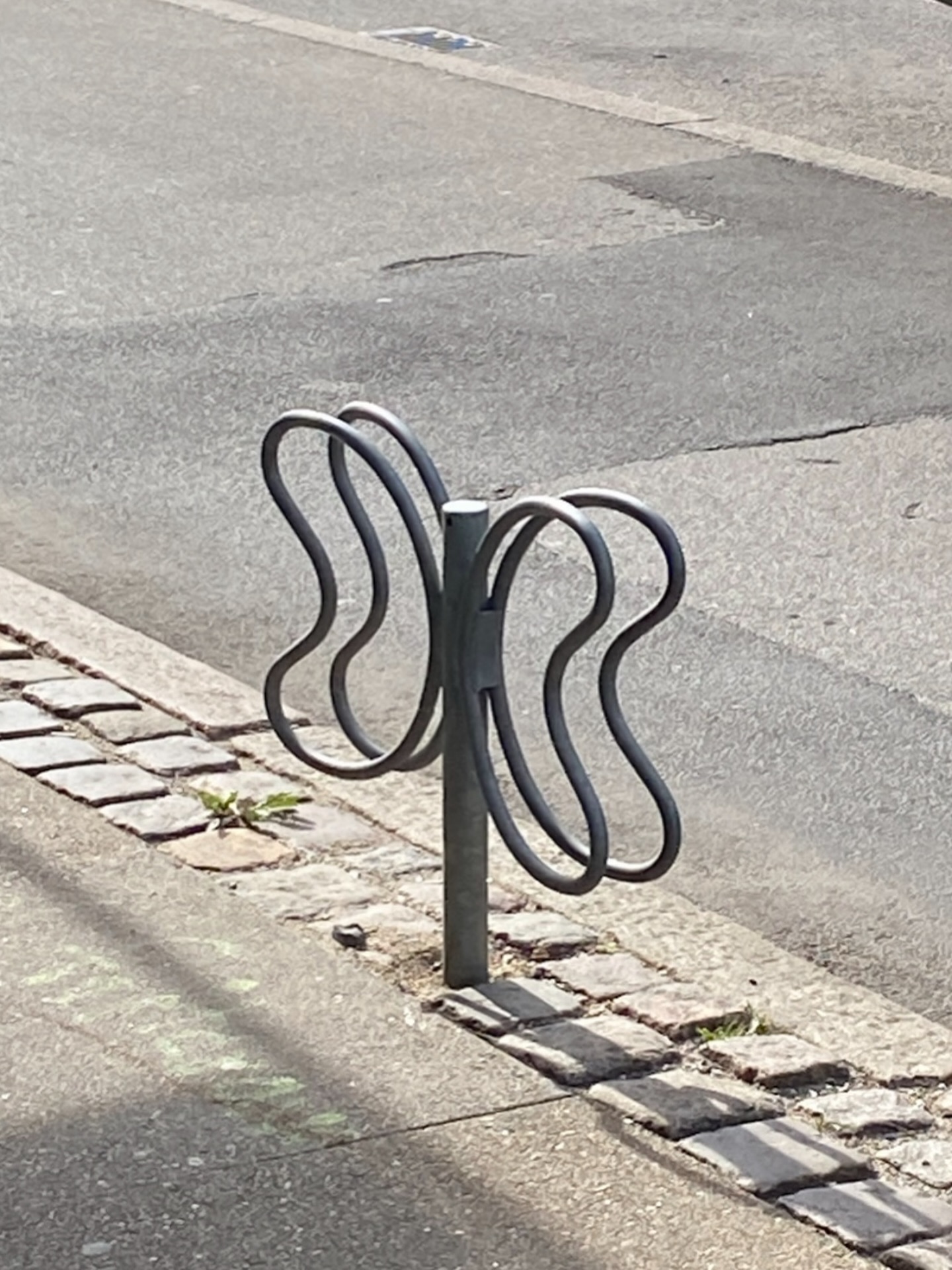
Editor’s note: I remember walking through Copenhagen with Cindy once when she suddenly said “Walk a bit further, keep walking”, while pulling out her phone. I had no idea what she was doing and just moved out of the way for her to take a picture. When she caught up with me, she showed me the photo she had taken: a regular double-sided bike rack – they are everywhere in Copenhagen and I see them on a daily basis. But the way Cindy had framed and zoomed in made it look almost like a butterfly. It perfectly captures how she sees the world – noticing the unnoticed and inviting others to see it too. Now, each time I see these double-sided bike racks, I think of a butterfly, and I think of Cindy.
I have this thing with circles. They very easily draw my attention. Circles and squares – the geometric aspect is very satisfying to me, and especially the balance between both shapes together. There’s something very calming about straight lines, shapes or even textures.
Walking in Copenhagen these past few months was very inspiring. Knowing that Denmark is a kingdom, a lot of remarkable details reveal themselves in architecture. It’s clear that attention to detail seems ingrained in Danish culture. Outside of the rich decorative elements linked to the monarchy, there’s also a strong sense of minimalism, and the mix of the two worlds leads to a city that is very well designed. I think that’s something that we are missing in today’s design because we usually see design as objects or buildings that need to reflect the future, like brand new, white and bright. Everything is picked from a catalogue with certain standards and that saddens me. I think we are just chasing time, and forgetting how important details are – like pieces of life.
When I’m out and about I’m often in my own head. The past few years I realised more and more that I notice things others don’t, and I tend to see the world differently. While walking with people, I’ll point out things they’d simply just pass by. When I try to explain what I’m seeing, they often don’t get it, and that’s why I started taking so many photos – it was a way of showing these little details that fascinates me. With my phone I can zoom, crop and highlight the things I see. In that way I captivate moments of my world and invite others into it.
No, not at all. For me, it actually does the opposite. Capturing a moment helps me hold onto the memory of that day. That’s why I take so many photos – I want to remember what I saw, and I also use them as inspiration. If I could do the same for conversations, I would – just write everything down to keep it. I should keep a diary, but I don’t. It’s been years since I kept up with one. When I lived in Copenhagen, I should have kept a diary so I could look back on my feelings and experiences from that time. At least I have pictures to hold onto the memories.
But my photos aren’t really linked to how I felt at the time I took them though, because I sometimes don’t remember. They are simply the leftovers of a visual reminder in a way, since I mostly remember through pictures.
My reference Instagram (@saatcheref) is like a library of inspiration for me. My camera roll is too chaotic, so it’s nice to post some of the best photos online instead. At first, I was afraid to share it to the public because I didn’t want to give people access to my ideas, my brain – but eventually I thought it might be better to share.
For me, walking around and taking pictures is also a way to clear my head. It’s a good way to find new inspiration – to go for a walk and notice things that might solve a design problem. I remember one project where I had to design a ceiling rail for sliding things like curtains. One afternoon, I was out on a walk and I noticed some carved stones packed together. The way they were stacked left a negative space that caught my attention. That simple gap sparked an idea for the opening of my ceiling rail, and that ended up inspiring the shape for my project.
“For me, walking around and taking pictures is also a way to clear my head. It’s a good way to find new inspiration – to go for a walk and notice things that might solve a design problem.”
“I’m truly fascinated by people who work in construction, how they solve problems using only tools and materials at hand. Their approach is so direct and grounded, not driven by aesthetics, and that gives me a deep sense of peace. It’s simple, logical, and comforting in a way.”
It's actually hard for me to stay focused in a social situation for very long. If it goes on for too long, I get exhausted and my mind and eyes start wandering. In that sense, I’m not really present with the people I’m with, unfortunately. People sometimes get frustrated when I’m not fully present, as my attention is on taking pictures and my mind drifts elsewhere – which is completely understandable. So I guess I’m present in my own mind, observing my surroundings, but not so much with others.
I feel like many people just walk from A to B, rushing through traffic, looking straight ahead or down at their phones. You could say they’re focused on the future – B being the future. For me, I can sometimes lose track of time, which is super annoying if I need to be somewhere. Sometimes I’ll pass something I want to photograph but don’t have time. Then I’ll go back later, even if it means a detour, just for that one photo – but it’s always worth it.
Well, that’s a really tough question, because my sense of taste has changed a lot over time. I guess I’ve grown more mature in how I understand beauty, especially in a world dominated by social media and advertising, where everything has to look picture-perfect. From food to fashion, to objects and people, everything appears flawless. But it has become so perfect in appearance that it no longer feels interesting to me.
Behind the scenes often lies poor composition, products made by workers in difficult conditions, and processes that worsen pollution through endless transport. This is, of course, tied to mass consumerism, something I’m trying desperately to avoid. I now try to find everything second-hand, from clothes to objects, or create them myself.
Today, I would define beauty as something where you can feel the human touch behind the creation – the presence of raw materials, and a sense of simplicity. I find an object beautiful when it’s no more complicated than it needs to be – design with purpose. To me, beauty is when something simply makes sense.
The only exception to that statement might be cultural heritage, which often embraces more ornate or expressive forms, and that too, can be beautiful in its own way, because it tells the story of humankind. That’s probably why travelling is so fascinating to me. The buildings and objects we encounter are shaped by different cultures, materials, and history. In contrast, that’s also why places filled with standardised furniture, like IKEA can feel a bit sad – they erase the singularity and soul of human-made environments.
I’m truly fascinated by people who work in construction, how they solve problems using only tools and materials at hand. Their approach is so direct and grounded, not driven by aesthetics, and that gives me a deep sense of peace. It’s simple, logical, and comforting in a way. That’s what I want to return to: the essence of problem-solving, people who face a challenge and simply find a solution.
For example, I took a picture of this birdhouse in an old Swiss private garden. To me, it’s beautiful precisely because of its structure. It only has what a birdhouse needs: a platform for food, a roof for shelter, and a pole for support. It serves its purpose; it’s simple, functional, and that’s what makes it beautiful.
I would even go so far as to say that a product must have a reason to exist as a new object. There are already so many products in the world, so if something new is created, it should serve a real purpose, or help preserve traditional craftsmanship, while being produced with as little pollution as possible. Ideally, it should also be easy to produce for the workers. All of these details are very important, even if we don’t think about them when we think ‘design’. For me, practicality always comes before aesthetics.
But aesthetics matter too. I’m trying to find a balance to create something both nice and functional, and maybe to find simpler ways to make it decorative without overcomplicating the materials or production.
A very important factor is also the way something is made: the materials chosen, and its purpose are all essential. If it’s durable and can last for years. Design shouldn’t be driven by profit alone. It should be created for long-term, sustainable use. Otherwise, it isn’t really a good design if it’s replaced after only a year or two. For example, when designing a chair, it first needs to work as a chair. You can make it as eccentric as you like in terms of aesthetics or materials, but if it doesn’t last or if you grow tired of it too quickly, it loses its purpose.
But then again, highly decorative design from the past is still good design, even without it having a purpose – just like the history of ‘the Doric order’ from ancient Greece. Originally, the columns were built in wood, and the larger decorated ends were purely for stability. Later, when stone columns were used to carry heavy stone roofs, that extra support in the ends was no longer needed because stone is strong enough on its own. But the shape and ornament stayed the same, purely for familiarity and aesthetics. I like that a design that once was functional can later become pure decoration – more of an origin story than a necessity.
So I do find beauty in non-functional decorative things, like ‘the Doric order’ or even something as simple as a teapot. The teapot itself has a purpose, but a decorative glaze doesn’t, and yet it can still be beautiful. For me, it just needs to stay connected to its origin, its story, and the craftsmanship behind it.
Design should tell a story, creating a connection to the things we own. That’s something we’re losing more and more with mass-produced plastic objects and what is often called ‘modern design’. When everything becomes a series of straight cubes with large windows, we lose our sense of cultural heritage. It also feels disconnected from what truly makes sense in the long run. Our lives and surroundings have become so dependent on energy just to maintain our comfort that we take for granted.
So functionality, purpose, and origin play a big role for me, both in my own designs and in how I connect with the work of others.
“A very important factor is also the way something is made: the materials chosen, and its purpose are all essential. If it’s durable and can last for years. Design shouldn’t be driven by profit alone. It should be created for long-term, sustainable use. Otherwise, it isn’t really a good design if it’s replaced after only a year or two.”
I think I draw inspiration from everything around me. Stepping into a new environment always triggers something. Sometimes travelling is a good way for me to open my eyes and senses more. That’s something I’m really interested in now because for a long time I tried to avoid travelling. I was always noticing the beauty in other cultures – every little detail in places like Paris or Copenhagen amazed me. But home in Switzerland, I couldn’t see it. When I got back from living abroad, I realised there are actually so many things here that are well thought out and tell a story, but I tend to overlook them once I get used to my environment.
That’s why my taste has been moving more and more towards something raw, almost like the countryside – very basic, simple, and primitive. To me, that’s the most honest form of objects. Recently, I rediscovered ‘Silvesterchläusen’, a tradition from Appenzell where my grandparents used to live. I definitely want to go see them this January – it feels deeply connected to the roots of craftsmanship and community that inspire me so much.
Walking through flea markets is always a huge source of inspiration to me – and books. I love going to the library and flipping through every book I can find, just to look at the pictures, like a kid. I have a few books at home too. Some are filled with images and others more focused on reading, about design and production, but also about people and how we live and coexist.
I was about to say “all the time”, haha, but I’m trying to learn to trust my gut more. I have a tendency to go along with other people’s opinions and decisions, even when I don’t agree, and I always end up regretting it. With age I’m gaining more confidence and stop giving in so easily.
In school, I really struggled to figure out what I wanted to do. When you start designing objects, you often go straight to the most ‘designy’ things, because you think that’s what you’re supposed to do – but in reality, it doesn’t make much sense. You have to educate yourself, and that’s where books really inspired me, and I found my own path that way.
So no, I’m not very confident, but that’s something I’m working on. Everyone wants to appear confident, and it’s tricky for me because I want to give the impression of confidence even though I'm really not. Confidence almost allows you to do whatever, and be whoever you want. But when it doesn't come naturally to you, it’s frustrating to see people with loads of confidence ending up with success, simply because they were able to sell themselves as someone they’re not.
I have mixed feelings about it. I don’t think it’s fair, but at the same time, I’m impressed. I’m just never going to be that type of person, so I hope my work will speak for itself. Even posting on Instagram feels scary. It’s a way of announcing to the world what you’re doing, and I’m not really active on LinkedIn for the same reason.
I want my work to speak for itself, but in today’s society marketing and capitalistic mindsets are front and centre. It seems like being more outspoken and extroverted often draws attention, while those who are quieter can be easily overlooked. You have to be loud and take up space to get noticed, which is far from my personality and comfort zone – but I know I need to work on it and eventually find a middle ground. It also goes against how I was raised in Switzerland and as a woman. There’s this modest barrier: don’t speak too loud, don’t outshine others – just do your job and live in peace. Very similar to the Danish ‘Jantelov’. That’s how I’ve lived most of my life, even though I know it’s not how success usually works.
I also think the school I went to plays a role; both teachers and students had a perfectionist mindset where everything you did was criticised. Nothing was ever perfect, and that negative feedback process taught me that everything has flaws. That’s actually comforting to know, but it also shaped how I see my own work and others’ designs – I’m always aware of what could be better, and that often leads to criticising it.
A good way I manage my perfectionism is by setting deadlines, even if there aren’t any. Otherwise, projects would never be finished. There’s always room for improvement, so you have to accept that it will never be perfect and set a deadline.
Criticism is never easy, but I’ve learned to remind myself that it’s okay. Everyone sees things differently, and there’s never just one right answer. Taste is personal, so you have to trust your gut. If I don’t like a product, I don’t have to buy it. And other people aren’t forced to buy mine either.
That’s also why marketing is difficult for me. Convincing someone to buy something can feel like lying, because you have to exaggerate or oversell, even when you know it has flaws. I think design should speak for itself. If you like it, it solves your problem, and it makes sense to you – then it’s right for you. It doesn’t have to work for everyone, and that’s okay.
Portraits by Naïma Stark
Reference images by Cindy Sacher
All rights reserved.